Author: Dr. Hannah Sinclair
Expertise: Academic Writing Specialist
Published: November 03, 2025
Last Updated: February 25, 2026
Presentation Anxiety: Public Speaking Tips for University Students
Category: Student Wellbeing & Skills | Read Time: 12 Mins
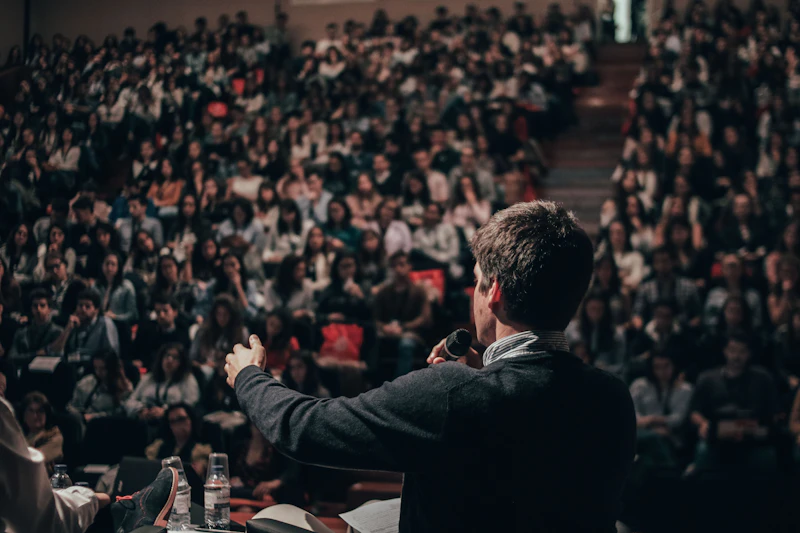
To overcome presentation anxiety, shift your focus from performance to communication. Prepare thoroughly using bulleted cue cards rather than a full script to avoid memory blocks. Practice "box breathing" (inhale for 4, hold for 4, exhale for 4) before speaking to lower your heart rate, and remember that your audience (and professor) actively wants you to succeed.
1. Introduction: The Universal Fear of the Podium
Your heart races. Your palms are sweaty. You feel a knot tightening in your stomach, and your mind suddenly goes blank. If this sounds familiar, you are experiencing glossophobia—the fear of public speaking.
Studies consistently show that public speaking is one of the most common fears among university students, sometimes ranking even higher than the fear of failing an exam. The pressure of standing in front of your peers and a professor who holds your grade in their hands is an intense, high-stakes environment.
However, presentation anxiety is not a personal failing; it is a standard physiological response to perceived stress. The adrenaline flooding your system is actually designed to help you focus, but when unmanaged, it leads to panic. In this guide, we are going to break down actionable, psychological, and practical steps to harness that nervous energy, conquer your fear, and deliver a Distinction-grade academic presentation.
2. Step-by-Step: The Anxiety Relief Protocol
Step 1: Cognitive Reframing (Changing Your Mindset)
The biggest driver of anxiety is the belief that a presentation is a performance, like a play or a concert, where every mistake ruins the show. You need to reframe this. An academic presentation is a conversation. You are simply sharing research you have done with people who haven't done it. You are the expert in the room on this specific topic. The audience isn't looking for a theatrical performance; they just want to learn something new.
Step 2: Structured Preparation (Ditch the Script)
Anxiety spikes when you fear forgetting your words. If you write a 1,500-word script and try to memorize it, you will panic if you forget the fourth word of the second paragraph. Do not memorize scripts. Instead, outline your presentation in concepts. Write 3 bullet points per slide on a flashcard. If you lose your place, you just look at the next concept and explain it naturally.
Step 3: Tactical Exposure (Practice in Context)
Practicing silently in your head does not prepare you for the physical sensation of speaking. You must practice out loud, standing up, with your slides clicking behind you. Record yourself on your phone. It feels incredibly awkward, but watching the recording is the fastest way to realize you don't look nearly as nervous as you feel.
Step 4: The 10-Minute Pre-Game (Regulating Biology)
Ten minutes before you speak, your fight-or-flight response will peak. You must manually override your nervous system. Use Box Breathing: Inhale for 4 seconds, hold for 4 seconds, exhale for 4 seconds, hold for 4 seconds. This signals to your vagus nerve that you are safe, artificially lowering your heart rate.
Step 5: The Launch (The First 60 Seconds)
The first minute is always the hardest. If you can get through the first 60 seconds smoothly, the anxiety usually dissipates by 80%. Memorize your opening hook and your introduction perfectly. Once you are past the intro, your preparation will take over.
3. Examples Students Can Understand: Internal Monologue Shifts
Your internal monologue dictates your physical reaction. Look at how changing your self-talk alters your presentation experience.
⌠The Anxious Monologue:
"Everyone is staring at me. They are going to notice my hands shaking. What if I stumble over the definition of 'macroeconomics'? The professor is writing something down—I must have just failed. I need to talk faster so I can sit down immediately."
The Result: The student rushes, runs out of breath, speaks in a monotone voice, and fails to engage the audience.
✅ The Reframed Monologue:
"My heart is beating fast because I have adrenaline, which gives me energy. The audience is looking at me because I am the one with the information. If I stumble on a word, I'll just pause, take a breath, and re-read my cue card. The professor is taking notes because I made a valid academic point."
The Result: The student embraces the adrenaline, maintains a steady pace, pauses when needed, and projects confidence even if they make a minor mistake.
4. Common Mistakes Anxious Presenters Make
- Apologizing for Being Nervous: Never start a presentation by saying, "Sorry, I'm really bad at public speaking." The audience usually cannot tell you are nervous unless you point it out. Start strong; fake it until you make it.
- Over-Caffeinating: Drinking a large iced coffee or energy drink before a presentation is a recipe for disaster. Caffeine mimics the physical symptoms of anxiety (jitters, racing heart), which tricks your brain into thinking you are panicking. Drink water instead.
- The "Flight" Response (Speeding Up): When we are scared, we want to escape. In a presentation, this manifests as speaking at 200 words per minute. You will run out of breath and stumble. Force yourself to speak 20% slower than you think is normal.
- Staring at the Floor/Screen: Avoiding eye contact makes you look defensive and unsure. You don't have to make deep eye contact; just look at the foreheads or the back wall just above the audience's heads. It looks exactly the same to them.
5. Practical Delivery Tips to Project Confidence
- The Power of the Pause: Silence feels like an eternity to the speaker, but it feels profound to the audience. If you lose your train of thought, do not fill the silence with "Ummmm." Simply stop, look at your notes, count to three, and resume. It makes you look thoughtful, not panicked.
- Hold Something Physical: If your hands shake, do not hold a single piece of paper (it will rattle like a leaf in the wind). Hold thick, sturdy index cards, or hold a clicker/presentation remote. It gives your hands a purpose and grounds your physical energy.
- Arrive Early: Rushing into the lecture hall 2 minutes before you speak spikes your cortisol. Arrive 15 minutes early, set up your slides, test the clicker, and get comfortable in the physical space before the room fills up.
6. Useful Academic Tools to Help You Prepare
Use these modern tools to practice your delivery and manage your nerves:
- PowerPoint Presenter Coach: This built-in AI tool listens to your practice runs. It alerts you if you are speaking too fast, using too many filler words, or just reading your slides out loud.
- Orai App: An AI-driven speech coaching app that provides instant feedback on your tone, pacing, and confidence levels. It essentially acts as a private speech tutor.
- Headspace / Calm App: These apps have dedicated 5-minute pre-performance meditation and breathing exercises specifically designed to lower cortisol levels before stressful events.
7. Frequently Asked Questions (FAQs)
1. Is it normal that my voice and hands shake?
Absolutely. Shaking is caused by adrenaline pulling blood away from your extremities to your core (the fight-or-flight response). To manage voice shaking, focus on taking deep breaths from your diaphragm rather than shallow breaths from your chest.
2. What should I do if I completely freeze and forget my lines?
Stop speaking. Take a sip of water (this buys you 5 seconds of normal-looking silence). Look directly at your cue cards, find the next bullet point, and just start reading from that point. Do not apologize; just move forward.
3. Should I look directly at my professor?
If looking at the person grading you makes you more nervous, avoid eye contact with them. Scan the room in a "W" or "M" pattern, looking at friendly faces among your peers instead. The professor will still note that you are engaging the room.
4. How do I handle a Q&A session if I don't know the answer?
Never lie or guess. It is perfectly acceptable in academia to acknowledge limits. Say, "That's a very insightful question. My scope of research didn't extend to that specific metric, but I would hypothesize [X], which warrants further investigation."
5. Do beta-blockers help with presentation anxiety?
Some students and professionals use prescribed beta-blockers to manage the physical symptoms of performance anxiety (like rapid heartbeat). However, this is a medical intervention that should only be discussed with a licensed doctor, not self-prescribed.
✅ The Pre-Presentation Checklist
Before your name is called to the podium, verify the following:
- 🔲 Have I practiced the presentation out loud, standing up, at least 3 times?
- 🔲 Are my notes written in short bullet points rather than full paragraphs?
- 🔲 Have I avoided caffeine for the last 3 hours?
- 🔲 Do I have a bottle of water within reach?
- 🔲 Have I completed 2 minutes of deep box-breathing to lower my heart rate?